
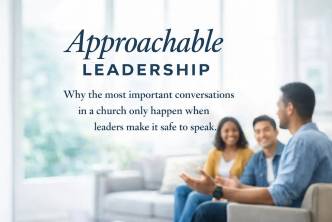
 Healthy leadership depends on many things. Wisdom. Character. Courage. But one quality is often overlooked and yet deeply influential: approachability.
I was twenty-nine years old when I entered full time ministry. Before that, I had spent several years working in corporate America, trying to navigate that environment as a young Christian. Like many believers in the workplace, I did my best to live with integrity, build good relationships, and figure out what it meant to represent Christ in a secular setting.
When I eventually moved into full-time ministry, I assumed the leadership culture inside the church would feel different from what I had experienced in the corporate world. In many ways it was. But in some ways it wasn’t.
As I began spending more time in leadership settings, I noticed some familiar dynamics. Narratives, or explanations, were sometimes inconsistent. One person might hear one explanation for a decision while someone else heard something quite different. At times it felt like the information you received depended on the audience you were part of.
In the name of “wisdom,” different information was sometimes given to different people. So essentially different explanations were given depending on who was asking. In a corporate setting, that kind of communication would not have surprised me. I just never expected to encounter it in a church setting.
Over time, though, I came to understand something important. Ministry doesn’t remove the human condition. It simply places it inside a spiritual environment. And that realization led me to another conviction. The church needs leaders who remain approachable. Because when leaders become difficult to approach, people stop speaking honestly. And when honest conversation disappears, dysfunction quietly takes root. If it goes unaddressed long enough, it eventually leads to sin and real damage.
Why Approachability Matters
Approachability is one of the most overlooked qualities in leadership. It rarely appears on leadership résumés. Churches often focus on a leader’s ability to teach, cast vision, organize ministry, or make decisions. All those things matter. But none of them can substitute for a leader who is genuinely approachable.
Approachable leaders create environments where people feel safe enough to speak honestly. That may sound simple, but leadership naturally creates distance. The moment someone carries authority, others become more cautious around them. Concerns are sometimes softened or left unspoken altogether.
In the church this dynamic can become even stronger because spiritual leadership carries moral and spiritual weight. People want to show respect for those who teach and shepherd them. That instinct is good and often healthy. But it can also create an unintended silence.
Members may notice something that concerns them but hesitate to say anything. Younger leaders may have questions about a decision but feel unsure whether it is appropriate to ask. Over time, that hesitation begins to shape the culture of a leadership team. Difficult conversations happen less often. Honest feedback becomes rare. Decisions move forward without the kind of open dialogue that might have strengthened them.
Most leaders do not intend to create that kind of environment. In fact, many would say they welcome feedback. But approachability is not defined by what leaders say about themselves. It is revealed by how safe others feel bringing difficult things to them.
Now I need to say something. I have never met a leader who didn’t think they were approachable. Yet some leaders that I have seen over the last twenty years were completely unapproachable. It was clear to everyone around them. It was clear to everyone except the leader.
And when that gap exists, the culture of a leadership team begins to change. Truth becomes harder to speak.
How Leaders Become Unapproachable
Most leaders do not wake up one day and decide they no longer want to hear from people around them. In many cases, unapproachable leadership develops slowly and almost unintentionally.
It often begins with small signals. A concern is raised and the first response is defensiveness. A question is asked and the person asking it is quickly corrected. A disagreement surfaces and the conversation ends abruptly.
None of these moments seem particularly significant on their own. But leadership cultures are shaped by patterns. When those patterns repeat themselves, people begin to notice and adjust.
Over time they learn something without anyone ever saying it directly. Certain conversations are welcome. Others are not. Questions that affirm leadership feel safe. Questions that challenge leadership feel risky.
So people adjust and begin to speak more carefully. They raise fewer concerns. Some conversations move away from the leadership table and into private side discussions.
The leader may not even realize this shift is happening. From their perspective, the team may appear unified and supportive. Meetings run smoothly. Decisions move forward with very little resistance.
In their minds, they are doing a great job. But the silence may not be agreement. It may simply be resignation.
Healthy leadership cultures make space for honest disagreement and difficult conversations. Unhealthy ones slowly train people to avoid them. And once that happens, leaders lose something they desperately need: truthful voices around them.
Why Leaders Need Truthful Voices Around Them
Leadership in the church was never meant to be exercised in isolation. Throughout Scripture we see a consistent pattern: God places leaders within communities where truth can be spoken, wisdom can be shared, and correction can happen when necessary. Approachability plays a crucial role in that process.
When leaders remain approachable, they allow truthful voices to remain close. People feel safe enough to raise concerns, ask difficult questions, or point out things that may need attention. And every leader needs those voices.
No matter how experienced someone becomes in ministry, blind spots never disappear. In fact, experienced leaders often need to work even harder at this. Both because of self reliance but also because those around the leader may take for granted that something has been thoroughly thought through.
Authority can also make those blind spots harder to see because fewer people feel comfortable pointing them out. That is why approachability cannot be passive. It has to be intentional. In fact, I would argue that if a leader is not intentionally making it easier for people to approach them, they are already becoming unapproachable.
Sometimes that requires leaders to create space for disagreement. One practical way I have tried to do this over the years is by explicitly inviting people to challenge my thinking. There have been times when I have said to someone on our team, “I need you to poke holes in this.”
When a leader says something like that, it does more than invite feedback from one person. It signals to everyone else in the room that disagreement is not only allowed, it is welcome. Without that signal, people often assume the opposite.
Leaders also need to guard against a certain kind of naivety. It is easy to ask people whether you are approachable and believe the answer when everyone says yes. But if people believe there is a price to pay for disagreeing with you, they will rarely tell you the truth. That is sad but true.
I remember one situation where our church leadership team was discussing how to respond to a difficult issue we were facing as a congregation. I came into the meeting with what I thought was a solid plan for how we should move forward. But instead of simply announcing the plan, I put it before our staff for discussion. Most of our staff at the time were younger leaders, largely Millennials and Gen Z. Only one couple was close to our age. After hearing their input, I left that meeting with a completely different plan.
Later I shared that story with a group of church leaders. What struck me was the number of private messages I received afterward from young leaders trying to understand our staff dynamic. Not because they were surprised that a leader would change his mind, but because in many places their input would not even be sought. That is a recipe for disaster. Maybe not today. But somewhere down the line that dynamic, left uncorrected, will cause major problems.
This is something I still have to work at intentionally. Approachability is not something a leader achieves once and then simply maintains forever. Left unattended, leadership almost always drifts in the opposite direction.
Authority, experience, and responsibility naturally create distance over time. If a leader is not intentionally working to keep the door open, that door slowly begins to close. Which is why approachability is not simply a leadership style. It is a discipline.
When Someone Brings a Concern
Something else I have tried to apply in my leadership is this: when someone approaches me with a concern about a decision I have made, I try to make that conversation the best experience that person has ever had with a leader. That may sound like a strange goal, but it is intentional.
I want that person to walk away feeling that they could approach me again. More than that, I want them to walk away believing that godliness should never be optional for those in positions of authority. I want their faith in God and their confidence in leadership to be strengthened. And I want them to feel that they matter and that they are a valued part of the body.
Now to be clear, this was not always my perspective. I remember many moments earlier in leadership where criticism immediately triggered defensiveness in me. That is often what insecure leadership looks like. Defensiveness is often the moment where approachability quietly dies. But leaders whose security rests in God do not have to protect their image in the same way. They can resist the urge to become defensive and instead listen carefully to what is being brought to them.
That does not mean every concern raised will be correct. And it does not mean every conversation will always be handled in the right spirit. There are moments when someone approaches a leader in a way that is not constructive or respectful. In those situations, part of leadership may involve helping people learn how to have those conversations more wisely. But even then, leaders should remember something important: the way we respond when someone approaches us often determines whether anyone will ever approach us again.
The Culture Approachability Creates
When leaders remain approachable, something important happens within a church.
Concerns can be raised before they grow into larger problems. Questions can be asked without fear of being dismissed. Different perspectives can be considered before decisions are finalized. None of this weakens leadership. In fact, it actually strengthens it.
Approachable leaders do not lose authority. They gain clarity. They gain the benefit of other people’s wisdom. They gain the protection that comes from having honest voices around them.
Unapproachable leadership may appear strong for a season because decisions move forward quickly and without resistance. But over time it creates something far more dangerous: isolation. And isolation has rarely served spiritual leaders well.
Perhaps the clearest picture of approachable leadership in Scripture is Jesus himself. People who had been ignored, dismissed, or pushed aside by society found themselves able to approach him freely. Children, sinners, the sick, and the marginalized all felt safe drawing near. Authority did not create distance around Jesus. It created invitation.
Scripture reminds us that leadership in the church carries a deeper responsibility before God. James warns that those who teach will be judged more strictly. Elders are called to shepherd the flock with humility, not domineering over those entrusted to their care.
Approachability is one of the ways that humility becomes visible in leadership. Healthy churches are not built on leaders who always have the final answer. They are built on leaders who are willing to listen.


