
 |
By Kyle Beshears
Mar 3, 2026
|
|
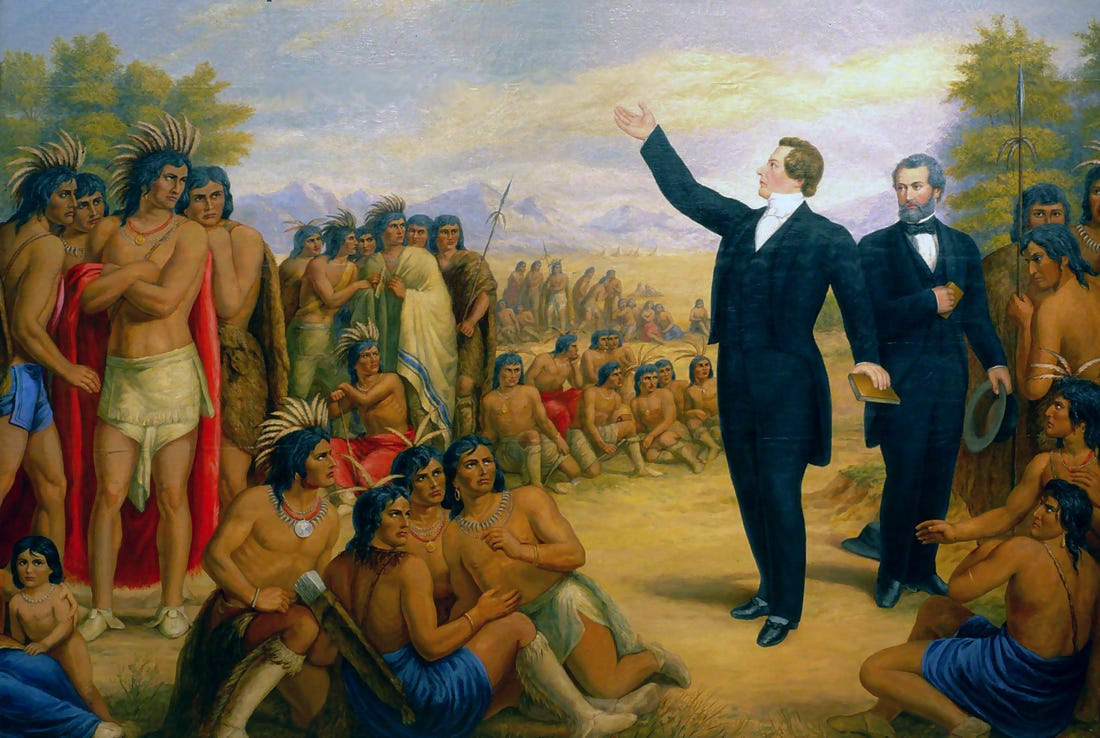 Joseph Smith Preaching to the Indians |
“Joseph [Smith] is a man of God, a prophet of the Lord set apart to lead the people—If we observe his words it will be well with us; if we live righteously on earth, it will be well with us in Eternity.” ~ Lucy Mack Smith, Mother of Joseph Smith
Joseph Smith Jr. was born in Sharon, Vermont, on December 23, 1805, to Joseph Smith Sr. and Lucy Mack Smith, the fourth of nine children. The Smiths were farmers whose several financial setbacks and relocations afflicted the family with challenges during Joseph’s adolescent years, leaving him, he explained, “deprived of the bennifit of an education suffice it to say I was mearly instructtid in reading [and] writing.” Those around him described Joseph as “quite illiterate” and “generally ignorant in common learning.” Joseph was quick to admit his scholarly shortcomings—his “weakness to a learned world”—especially his poor grammar and “inability in conveying [his] ideas in writing.”
Still, “he always seemed to reflect more deeply than common persons his age,” recalled his mother, especially “upon everything of a religious nature.” Her son was bright, inquisitive, and filled with charisma, all characteristics that would later influence the development of his religious beliefs. Neighbors remembered him as “a real clever, jovial boy,” even if, at times, he came across as “pompous [and] pretentious.”
The Smiths moved to Palmyra, New York, in 1816, near the site of the future Erie Canal. They worked in a store and as hired hands until they could lease a one-hundred-acre lot just south of town. There, the Smiths constructed a modest cabin and cleared land to establish a farm. The family’s reputation among their neighbors was mixed. On the one hand, the Smiths labored exhaustively to make their farm productive and to secure financial peace. They felled thousands of trees to clear enough land to plant crops and a large orchard. Eventually, they produced sugar and started a small cooperage. But on the other hand, they struggled economically, which led some neighbors to complain about the Smiths. More than anything, it was the treasure digging that raised their neighbors’ eyebrows. The family was rumored to divert their time and energy away from farming toward excavating treasure with magical seer stones, which cast a shadow over their reputation. “In short, not one of the family had the least claims to respectability,” said one acquaintance bluntly. “They were poor as well as worthless,” claimed another neighbor, a point amplified by fifty-one others who asserted the family was “destitute of that moral character, which ought to entitle them to the confidence of any community.” Others didn’t mind the Smiths, describing them as “big hearty fellows” and a “good family” who made “good neighbors.” Either way, the Smiths were marginalized, “a low family and of no account in the community,” whether by their own doing, prejudice, or both. Discerning the Smiths’ character is difficult. Were they an innocent and industrious family misunderstood by outsiders, or was the family business a blend of agriculture and dupliticy? One thing about them, however, was clear: the Smiths valued religion.
Years earlier, after a lifetime of resisting the gospel, Joseph’s grandfather, Solomon Mack, was converted after heeding Christ’s invitation to “come unto me, all ye that labour and are heavy laden, and I will give you rest” (Matt 11:28). Having repudiated his Universalist convictions, Mack was pressed by the weight of his sin until, after a series of nightly visions—seeing lights and hearing his name called—he prayed for mercy and finally “found Christ’s promises verified that what things soever ye ask in prayer, believing, ye shall receive.” It was in the gospel promise of rest where Mack found redemption.
His grandson Joseph later found himself in a similar condition, weighed down by the guilt of sin. Although he was raised by “goodly Parents who spared no pains to instructing me in the christian religion,” he said, and even though he believed the Bible “contained the word of God,” he was unsure of his salvation. “I felt to mourn for my own sins,” he wrote, and worse, “for the sins of the world.” He sensed a sort of universal apostasy “from the true and living faith” among those who claimed Christ’s name, evidenced by their “contentions and divisions.”
Joseph’s own home was not spared. His father, Joseph Sr., once a founding member of a Universalist society, later rejected organized religion in favor of individualist spiritualism, a position Joseph Jr. seemed to share. “I can take my Bible, and go into the woods, and learn more in two hours, than you can learn at [church] in two years,” he reportedly told his mother, Lucy. But she felt differently, preferring instead to align herself with Presbyterianism, a more structured form of faith. The fiery revivalism of the Second Great Awakening only added to Joseph Jr.’s confusion. At camp meetings, preachers stirred up crowds to repent and receive the Holy Spirit. Joseph said he wanted “to feel & shout like the Rest but could feel nothing.” At an early age, he sought a quiet, personal revival in a grove near his family’s cabin. There, Joseph claimed to commune directly with God, a pivotal moment that marked the beginning of Mormonism. The vision was followed by angelic encounters, the discovery of ancient gold plates, the publication of the Book of Mormon, and the humble beginning of a tiny church that grew from a handful to millions.
A Prophet Under Pressure
The growth of the church came at a tremendous cost to Smith. At first, he weathered rhetorical criticism from skeptics. The public fixated on Mormon heterodoxy, like the Book of Mormon and the church’s charismatic practices. Skeptics pitied the Mormons as “a deluded set of men” mesmerized by the “fanatic illusions” of a false prophet who “pretends to cast out devils, to give the Holy Ghost by laying on of hands, to heal the sick, &c.” “Jo Smith” took the brunt of public criticism as clergy railed against him in the pulpit and pamphleteers did so in print. But in 1832, rhetorical opposition swelled into violent intimidation. Smith was abducted, beaten, and tarred and feathered. The mob hoped to silence the would-be prophet, but in the long run, their actions had the opposite effect. Smith wore the scars of persecution proudly. In the years to come, many of his followers would share in his suffering. In fall of 1838, for example, at Hawn’s Mill in Missouri, an anti-Mormon militia massacred seventeen men, women, and children. Smith constantly faced challenges protecting his followers and dealing with church opposition.
Legal challenges also plagued the prophet. Smith was arrested and faced trials on numerous occasions. He was charged with fraud, adultery, and treason, among other allegations. Smith often pled his innocence despite being vilified. “These are falsehoods,” he once said, decrying how his own “mormon dissenters are running through the world and spreading various foul and libelous reports.” Antagonism and persecution from external opposition permeated Smith’s anxiety, but he found relief by interpreting his enemies’ resentment as a sign of God’s favor. In stirring up the people against Mormons, Smith said his critics hoped “to gain the friendship of the world because they know that we are not of the world and the world hates us” (see John 15:19). Let anti-Mormons befriend the world; the Saints were friends of Zion.
But all was not well in Zion. While external enemies battered the church, internal dissent threatened Smith’s leadership. Some Mormons challenged him, especially his decisions around financial stewardship and doctrinal developments, which led to factions. In 1837, a small but powerful schism led by Warren Parrish claimed ownership of the Mormons’ first temple in Kirtland, Ohio. Parrish, who served Smith as a clerk, broke from his prophet after the two exchanged accusations of financial mismanagement. And later, in 1844, William Law, formerly Smith’s counselor, organized a breakaway congregation in Nauvoo, Illinois, then the headquarters of the church. Law’s group opposed polygamy and polytheism, which they accused Smith of having introduced after becoming a fallen prophet.
Under constant pressure from enemies without and dissenters within, Smith emerged not as a weathered leader but as a prophet increasingly defined by bolder claims, expanding authority, and escalating demands for loyalty.
A Prophet of Paradox
Smith was a pastoral and compassionate leader. He celebrated with newlyweds at weddings, attended the sick, and wept with mourners at funerals. He advocated for victims of domestic abuse, prayed over a crisis pregnancy, and consoled a woman whose baby died on Christmas Eve. Smith was hospitable, having received many people into his home, so much so that at times he described being “hindered by a multitude of visitors” but received them as gifts: “May God grant to continue his mercies unto my house,” he prayerfully journaled.
Smith’s compassionate hospitality stemmed from genuine concern about his community’s welfare. He desired to alleviate poverty among his people and encouraged his followers to “cultivate sympathy for the afflicted among us.” During church trials, Smith sometimes “acted on the part of the defence for the accused to plead for mercy.” He was patient with those he found to be sincerely humble and quick to reject those who were not.
But Smith was also short-tempered. For example, when the governor of Illinois, Thomas Ford, issued a warrant for Smith’s arrest in June 1843, he fiercely prophesied “in the name of the Lord God” that Ford was damned and his “carcass will stink on the face of the earth.” A little more than a week later, a calmer Smith yielded to Christ’s command to love one’s enemies (see Matt 5:43–44), rightly recognizing that “if we would s[e]cure & cultivate the love of others we must love others, even our enemies.” In the face of adversity, Smith rightly advised his people to “be cool, be deliberate [and] be wise.” Had he consistently practiced his own advice, perhaps he would have lived longer. His short temper prompted his rash decision to order Nauvoo’s militia, which he controlled, to destroy a printing press after it published unflattering information about him. This event was the catalyst that led to his death in 1844.
Still, Smith strove to respect all people. “I feel myself bound to be a friend to all the sons of Adam,” he wrote, “whether they are just or unjust, they have a degree of my compassion & sympathy.” These words take on more significance knowing Smith wrote them about John C. Bennett, a con man who quickly rose through church ranks only to be outed for moral hypocrisy, a vice that Smith despised. “I love that man better who swears a stream as long as my arm, and administering to the poor and dividing his substance, than the long smoothed faced hypocrites,” he said, because he believed “it is the delight of my soul to be honest.” Yet despite his disdain for duplicity, Smith was occasionally guilty of it. In May 1844, after enduring years of accusations of adultery for practicing “Spiritual wifeism,” he very publicly denied his involvement with polygamy, which would have been a shock to the women with whom he had privately entered into celestial marriage. True, Joseph dearly loved his first (and only legal) wife, Emma, whom he called “the choice of my heart,” yet he caused her deep, emotional pain. She “wept considerable” after being presented with a supposedly “Holy Law,” the “new and an everlasting covenant” of marriage in which her husband was commanded by God to take additional wives (see D&C 132:1–2, 34–39, 51–52).
Perhaps this kind of conflicted incongruity is to be expected from a man who said he was simply “but a man” and that his followers “must not expect him to be perfect.” “I don’t want you to think I am very righteous,” he said, “for I am not very righteous.” Still, as admittedly flawed as he was, Smith claimed to be God’s prophet. Whether or not one accepts his claim inevitably frames their understanding of his character, life, and legacy.
— Kyle Beshears (PhD, The Southern Baptist Theological Seminary) is Campus Pastor at Mars Hill Church in Mobile, Alabama, and has taught religion at the University of Mobile. He wrote his dissertation on Mormon history, has published in the Journal of Mormon History, and serves on the board of the John Whitmer Historical Association. More than ten years of interfaith dialogue between evangelicals and Latter-day Saints equips him to blend academic research with pastoral engagement.
---
Excerpted from 40 Questions About Mormonism by Kyle Beshears (Kregel Academic, 2026). Used by permission.
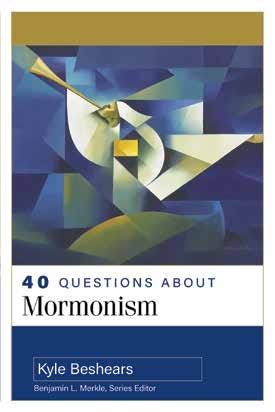
Author Kyle Beshears draws on years of dialogue with LDS church members to ask and answer the most pertinent questions for understanding today’s Church of Jesus Christ of Latter-day Saints, covering history, sources of authority, doctrines shared with Christianity, unique doctrines, and more. Among the questions addressed, these are included:
- Is Mormonism just an American religion?
- How do Latter-day Saints view the Bible?
- What is the origin of the priesthood?
- What is the Latter-day Saint view of Jesus Christ?
- Why does Mormonism have temples?
- What are concerns Latter-day Saints have about traditional Christianity?
The historically and biblically discerning answers allow readers to better understand both traditional Christian faith and the distinctive elements of Mormonism. Readers will feel more confident forming friendships with LDS adherents, viewing them as neighbors whom God loves and witnessing to them as such. Instructor resources are available at 40questions.net.
 |
“40 Questions About Mormonism makes a strong bid to become the go-to Christian resource on Mormonism. As a long-time pastor in Utah, I appreciate the thoroughness and accuracy of the information it presents as well as its engaging tone. Drawing on the author's admirable grasp of Christian history and biblical theology, as well as his solid research into Latter-day Saint doctrine, history, and culture, the book analyzes all the important issues that divide Mormonism from traditional Christianity. It does so, not only with depth and insight, but also with the graciousness and fairness that invites Mormons to listen.” — Ross Anderson, Author of Understanding Your Mormon Neighbor
“40 Questions About Mormonism is an invaluable resource for Christians, religious scholars, and anyone interested in understanding the Church of Jesus Christ of Latter-day Saints. Its blend of historical analysis, theological comparison, and practical advice makes it a standout work in its field.” — Sandra Tanner, Co-founder of Utah Lighthouse Ministry
Find 40 Questions About Mormonism at Amazon, Barnes & Noble, Christianbook.com, Books-A-Million, and Walmart.


